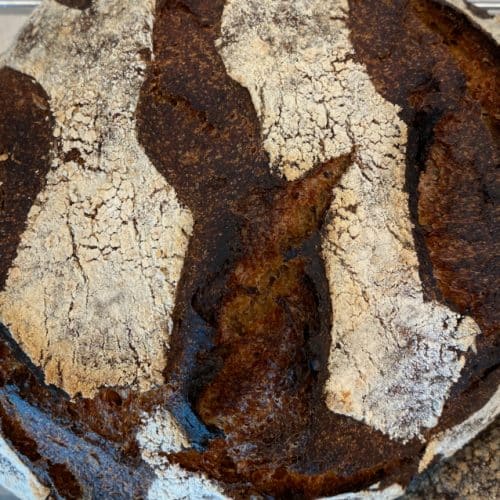
Sourdough with 50 % wholegrain flour
Spelt, Rye and Whole Grain flours plus added malt extract and molasses means that this loaf packs a nice punch
Ingredients
Levain
- 55 g Ripe Starter
- 55 g Water
- 27 g Spelt Flour
- 27 g Malted Strong Bread Flour
Autolyse
- 493 g Malted White Bread Flour
- 233 g Whole Grain Spelt Flour
- 208 g Wholemeal Wheat Flour
- 52 g Rye Flour
- 830 ml Water
- 20 g Fine Sea Salt
- 164 g Ripe Levain
- 1 tbsp Molasses
- 2 tbsp Malt Extract
Instructions
Levain
- Combine 55g ripe starter and 55g water with a whisk to get a slurry
- Add 27g spelt flour and 27g malted bread flour, combine making sure there are no dry bits
- Set aside covered loosely for 3 hours
Autolyse
- About 30 mins before the levain is ready, combine your flours in a large bowl
- Add to this about 700ml of the water and combine using a dough hook attachment on your stand mixer. Once flour and water is fully combined cover with cling film for 30 mins. The reason that I don't add all water at this stage, is the high hydration of this bread. By not introducing too much liquid it becomes easier to handle.
- Add molasses and malt extract to a little bowl and pour over a small amount of boiling water to loosen it up making it easier to combine with the rest of the dough. I make sure that there isn't more than 100ml total, as you don't want to add too much liquid to the dough as this makes it very difficult to handle
Mix
- At this point the levain is ready and it's time to mix it into the autolyse
- Add levain, salt and malt/molasses mix to the autolysed flour at a slow speed. Once fully combined turn up the speed on your stand mixer to work to dough for 3 minutes
- I follow this with 5-8 mins of "slap and fold" technique to really strengthen the dough. If you prefer to knead the dough more traditionally, that's also an option.
- Transfer to your bulk container or do as I do put it back in the mixing bowl. The main point here is that there needs to be space to the to rise as it proves
Bulk Fermentation
- Bulk fermentation takes 3.5 hours. You will need to perform 3 sets of "stretch and fold". the first is 15 minutes in to bulk fermentation and the next two are at 30 mins intervals following that.
- Stretch and fold is when you with your bowl in front you, one hand on the bowl and the other grabs and lifts the dough at 12'o'clock and fold it down to 6'o'clock. Give the bowl a quarter turn anti clockwise and repeat: grab, lift and fold over. Do this a total of 4 times.
- Once you've performed your third stretch and fold it's time to leave the dough to rest the remainder of bulk fermentation: 2hrs15mins
Divide and Preshape
- Have your bench knife and a small bowl of water ready
- Turn out the dough gently on your work top
- Divide the dough in two with your bench knife, you've wetted in the bowl, and your wet hand pulling the dough apart from each other The water helps the dough not sticking to your knife or hands much like flour will do later
- Repeat this action twice: imagining an envelope, fold top, right, bottom and left toward the center creating a new seam. Flip the over so the seam is underneath. Now you wanna try and get some tension across the top, so it doesn't splay out while resting. To achieve this give the dough a few turns with the help of your hand and bench knife. Now leave the two loaves to rest on the work top for 20 mins
- Lightly flour the top of the dough dome. Now flip it over so the floured surface in now towards the work top. As you flip it over try to pull the dough and thereby elongate it, making it oblong in shape. Now grab the left and right hand side and fold it over towards the opposite side creating a zigzag pattern along the dough.
- Starting with the end furthest away from you, fold it over simultaneously pressing lightly with your thumbs. Do this again and again until you have a little boule closest to you.
- Flip that over so the new seam is on the work top
- Now you have to try and build up tension across the surface with the help of your hand and bench knife turning the boule almost tugging the dough underneath it self.
- Transfer this to your proofing basket, cover it in a clean plastic bag and transfer to the fridge where it will cold bulk ferment until the morning (up to 24 hours)
- Repeat with the second loaf
Bake
- Preheat oven at 265C fan with your Dutch oven or other oven proof cast iron casserole in side
- Have a chopping board and grease proof paper ready and blade or very sharp knife for scoring
- Prepare work top with heat resistant coasters
- Once oven is at temperature, remove one loaf from the fridge
- Remove the plastic bag exposed the loaf.
- To turn out the loaf put the grease proof paper over your bowl, topped by the chopping board. Flip over the basket, so that the loaf is on top of the paper
- Score the loaf with four slices across the top forming a box
- Using oven mitts take out your Dutch oven
- Transfer your scored loaf, cover and return to the oven, turning down the temperature to 235C. Cook for 20 mins covered
- After 20 mins carefully remove the lid. Continue cooking for another 30-35 mins
- Remove the loaf and leave to cool on a wire rack for a couple of hours
- For the second loaf first return the lid to the oven and preheat again to 265C and repeat the previous steps